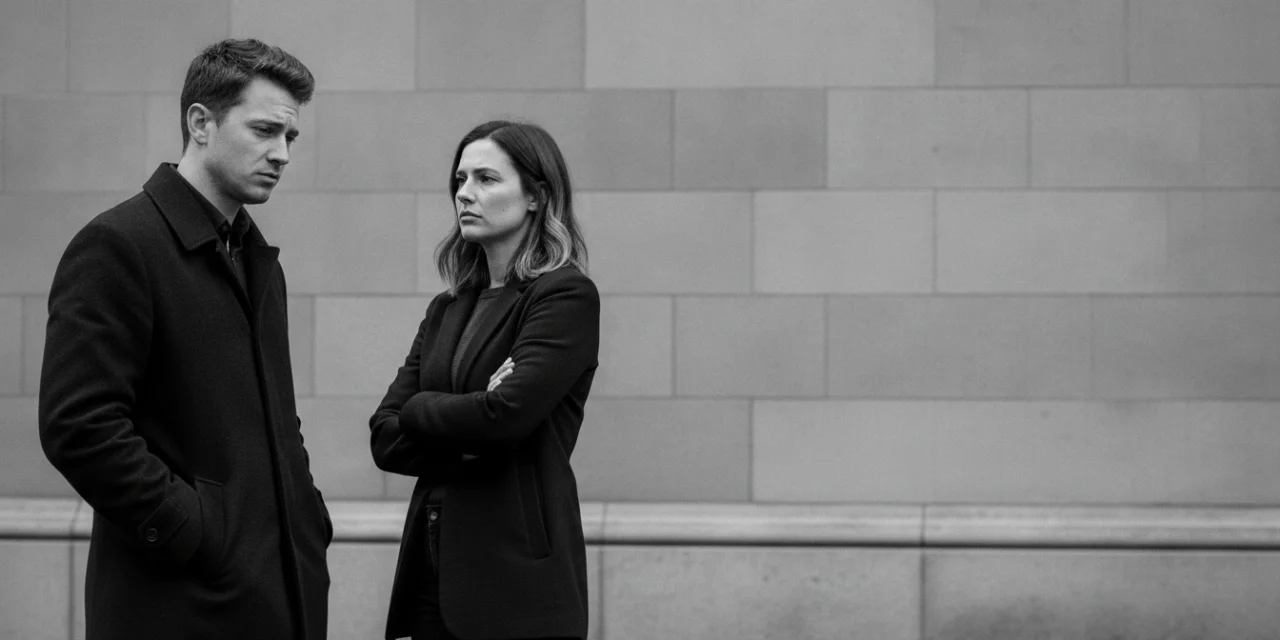
Conflict relations are relations of two-way damage: the main strength of each partner lands exactly on the other’s most vulnerable spot. Of the 14 kinds of relations between the 16 types in the CoreTypes system, this pair has the worst prognosis for close distance and, by the construction’s irony, one of the strongest pulls at long range. Which is why they’re worth knowing about before they happen to you.
First, a reassurance: “conflict” doesn’t mean the pair necessarily fights. Many conflict unions are outwardly quiet. The point is different: two people wound each other by their very way of existing, without intent and without an off switch.
The combination can only be checked through types. Yours takes minutes: the free CoreTypes test.
What Are Conflict Relations
Recall two details of a type’s construction. The Leading function is the main strength, running constantly and without effort: a person literally lives by it. The Vulnerable function is the opposite pole: a zone of chronic insecurity where any touch lands painfully. In a conflict pair these zones are docked crosswise: the Leading function of each falls exactly on the Vulnerable function of the other. Functions are covered in the 16 CoreTypes theory.
Note the difference from revision, often confused with conflict: there the sight points one way, here both ways. No safe participant. Both fire, both are under fire, neither on purpose.
The partners also come from opposite value quartets and different temperaments: one rational, the other irrational. The pair has almost no shared footing, which makes its unlikeness so striking. And so intriguing.
The Mechanism: Two Spotlights Into Each Other’s Eyes
Take the Grandmaster (INTJ, known in socionics as Robespierre) and the Duke (ESFP, Napoleon in socionics). The Grandmaster’s Leading function is Structural Logic: system, principles, precision of wording. His Vulnerable one is Volitional Sensing: direct pressure, onslaught, the fight for territory. In the Duke it’s mirrored: his Leading function is Volitional Sensing, drive and influence as a way of life; his Vulnerable one is Structural Logic: schemes, regulations, and “define your terms” fill him with dull anguish tinged with panic.
Now move them into one apartment. The Duke doesn’t attack; he simply lives: enters loudly, decides broadly, pushes plans through, fills the space with himself. Every gesture is pressure: a direct hit into the Grandmaster’s vulnerable zone, where it gets cramped and anxious. The Grandmaster doesn’t attack either; he simply speaks: refines wordings, builds rules, notes logical holes. Every remark is structure: a direct hit into the Duke’s vulnerable zone, where he feels like a student at an eternal exam in his worst subject. Both tire at a speed they can’t explain. Nobody is guilty. Both hurt.
The same cross looks different in another pair. The Beacon lives by emotion: feasts, guests, loud joy, his Leading function. For the Seer the emotional element is the Vulnerable one: raucous merriment is like bright light in the eyes, and he defends himself the only way he can, with irony. One smirk of his about “this circus” can put out the Beacon’s whole evening. In return, the Seer’s Leading function is time and forecasts: “by March it’s too late, count back from the deadline.” For the Beacon, whose Vulnerable function is time, every such calculation sounds like a siren: he already lives feeling late everywhere. Both are just talking. Both feel worse after.
The key word of the mechanics is “constantly.” A Leading function can’t be switched off: it isn’t behavior, it’s a mode of existence. That’s why a conflict pair can’t “just agree not to touch each other’s spots”: the touching is built into the contact itself.
Why the Conflict Partner Is So Attractive From a Distance
The most treacherous part. Look at the scheme again: the partner is strong exactly where you are helpless. Sound familiar? It’s the dual formula. From afar, a conflict partner looks almost like a dual: the person whose strong suit is precisely what hurts you. The Grandmaster is mesmerized by the Duke’s freedom and drive: cover my anxious zone with that. The Duke is impressed by the Grandmaster’s clarity and system: that mind, on my sore subject.
The difference is in the delivery. A dual feeds your weak zone gently: his strength arrives at your Suggestive function, open, expectant, absorbing. A conflict partner delivers the same nominal help into the Vulnerable function, a zone that doesn’t accept help but defends against it. The same medicine: one gets it intravenously, the other into an open wound. Which is why falling in love with a conflict partner is common: from afar it genuinely resembles meeting your missing half. Up close, the half doesn’t dock; it presses.
The Eight Conflict Pairs
| Pair | One’s Strength, the Other’s Pain |
|---|---|
| Grandmaster and Duke | System versus onslaught: each demolishes the other’s footing simply by being. |
| Beacon (ESFJ, Hugo) and Seer (INTP, Balzac) | Celebration and forecast: joy wilts from irony, irony drowns in noise. |
| Catalyst (ENTP, Don Quixote) and Custodian (ISFJ, Dreiser) | Ideas versus foundations: one feels cramped, the other alarmed. |
| Harmonist (ISFP, Dumas) and Executor (ENTJ, Jack London) | Peace and race: one’s tempo is the other’s torture. |
| Flamekeeper (INFP, Yesenin) and Overseer (ESTJ, Stierlitz) | Dream and standard: lyric reads as laziness, order as a cage. |
| Warlord (ESTP, Zhukov) and Sage (INFJ, Dostoevsky) | Force and conscience: each is a living reproach to the other. |
| Herald (ENFJ, Hamlet) and Craftsman (ISTP, Gabin) | Passion and pragmatics: the flame breaks against imperturbability, and rages. |
| Sentinel (ISTJ, Maxim Gorky) and Harbinger (ENFP, Huxley) | Regulations and freedom: one closes doors, the other flings them open. |
From outside, all eight look like “an interesting pair of opposites.” From inside: two people, each dreaming of a vacation from the other and ashamed of it.
How the Conflict Plot Unfolds
Phase one: intrigue. The unlikeness fascinates; the partner’s strengths look like the answer to your own weaknesses. These are often bright, fast romances: faster than dual ones, whose pull is quiet.
Phase two: accumulation. The first jabs get written off as adjustment. But unlike normal adjustment, where friction decreases with time, here it accumulates: every day adds hits to the sore spots, and both psyches shift into defense mode. A chronic fatigue from the partner appears, unexplained by any single quarrel.
Phase three: talks that lead nowhere. The pair feels something is wrong and discusses it, but the discussions stall: each describes his pain in the language that happens to be the other’s sorest. The Grandmaster brings the Duke a structured analysis of the couple’s problems, point by point. The Duke hears only the crushing scheme. The Duke answers with an emotional onslaught; the Grandmaster hears only pressure. Healing attempted with the very instrument that wounds.
Phase four is a fork: distance, internal or literal, or mutual burnout. Conflict marriages that reached calm almost always got there by widening the distance: separate domains, separate rest, careful neutrality.
The Myth: “Love Conquers All, Hard Relationships Forge Us”
The myth: if a relationship is hard, that’s proof of its depth; work on yourself and everything will settle.
Work on a relationship is real, but it has limits. In a conflict pair the source of pain is not habits or character, which can be corrected, but the base construction of both, which cannot. “Working on yourself” here means demanding that a person stop being themselves, in both directions, for decades. The result isn’t tempering; it’s depletion. Years inside a conflict marriage get described identically: “I forgot how to be myself; I’m always the wrong one.”
This doesn’t mean “leave immediately”: live couples are more complex than schemes, and what actually helps is below. It translates into something else: stop searching for the guilty. Nobody in this pair is an abuser or a victim by character; the two of them hurt constructively. That knowledge alone removes half the mutual accusations. Understanding your own construction, your strengths, your vulnerability, what you actually need from a partner, is what the expert personality profile is for: a detailed book about your type.
What Helps a Conflict Pair
Distance inside the household. Separate rooms, separate schedules, autonomous territories: everything that lowers the density of contact lowers the number of hits. Conflict couples living “in parallel” feel noticeably better than couples living “point-blank.”
Guarding the sore zones, by list. Sit down and name them: this hurts me, this hurts you. Not to stop (that won’t happen), but to remove these topics from arguments, jokes, and educational campaigns.
Translators. Third parties, mutual friends, a family therapist, writing instead of speech: any channel where messages arrive not head-on. Everything that reduces the immediacy of contact serves this pair.
And an honest horizon: the goal is not an ideal union but coexistence without destruction. That is achievable. How your type behaves in all 14 kinds of relations, and with whom it finds things easy, is covered in the relationship books for your type.
Where a Conflict Partner Is Useful
At the right distance, this is a valuable person. He natively commands the entire area you lack: as a consultant in his field, irreplaceable. The Duke won’t find a better systematizer than the Grandmaster; the Grandmaster won’t find a better negotiator than the Duke. The format: short contact, a specific task, a respectful distance.
And one more thing: the conflict partner is the clearest demonstration of your type’s limits. Looking at him, you see what you will never be, and that, oddly, liberates: you stop demanding someone else’s strength from yourself.
How to Recognize Conflict Relations
The signs: a bright pull of unlikeness at the start, inexplicable mutual fatigue up close, and problem-talks that become a problem themselves. But revision and Super-ego give similar symptoms, and the tactics differ, so the diagnosis deserves precision: through types.
The familiar order: the free test analyzes which wordings you choose and gives a first hypothesis; the recorded interview, 40 to 60 minutes of your reflections with an expert semantic analysis of your speech, determines the type with accuracy close to one hundred percent. For decisions on the scale of “marry or part,” accuracy is not the place to economize.
Frequently Asked Questions About Conflict Relations
Is a conflict marriage doomed?
Not doomed, but it demands more awareness than any other: distance inside the household, guarded sore zones, lowered expectations of “total merging.” Couples who build that, live. Couples who wait for love to conquer everything burn out. Honesty beats optimism here: this is the most expensive relation to maintain.
Why was I so drawn to exactly this person?
Because from a distance a conflict partner looks like a dual: strong exactly where you are vulnerable. The mistake isn’t in your feelings but in the optics: the way he “covers” your weakness turned out to strike rather than feed. That knowledge, by the way, is the best protection for the future.
How does conflict differ from revision?
By the direction of fire. In revision one is under the sight and the other is comfortable. In conflict, both. Revision is more insidious (harder to notice); conflict is more destructive (hits from both sides).
Who is my type’s conflict partner?
All eight pairs are in the table above. The field mark: a person whose ordinary manner of living feels aimed personally against you, and who, by all appearances, thinks the same of you.
Instead of a Conclusion
Conflict relations are the one kind of the fourteen where warning is more honest than inspiration. Not for fear’s sake, but for navigation: the heaviest unions happen not to bad people but to unchecked geometry. The check takes less time than one hard conversation: the free CoreTypes test for a first hypothesis about your type, the recorded interview for confirmation with accuracy close to one hundred percent. Knowing the map doesn’t mean fearing the terrain. It means choosing the roads.