Hear a person's type yourself
The first step toward hearing a person's type: not an expert yet, but with an ear you didn't have before
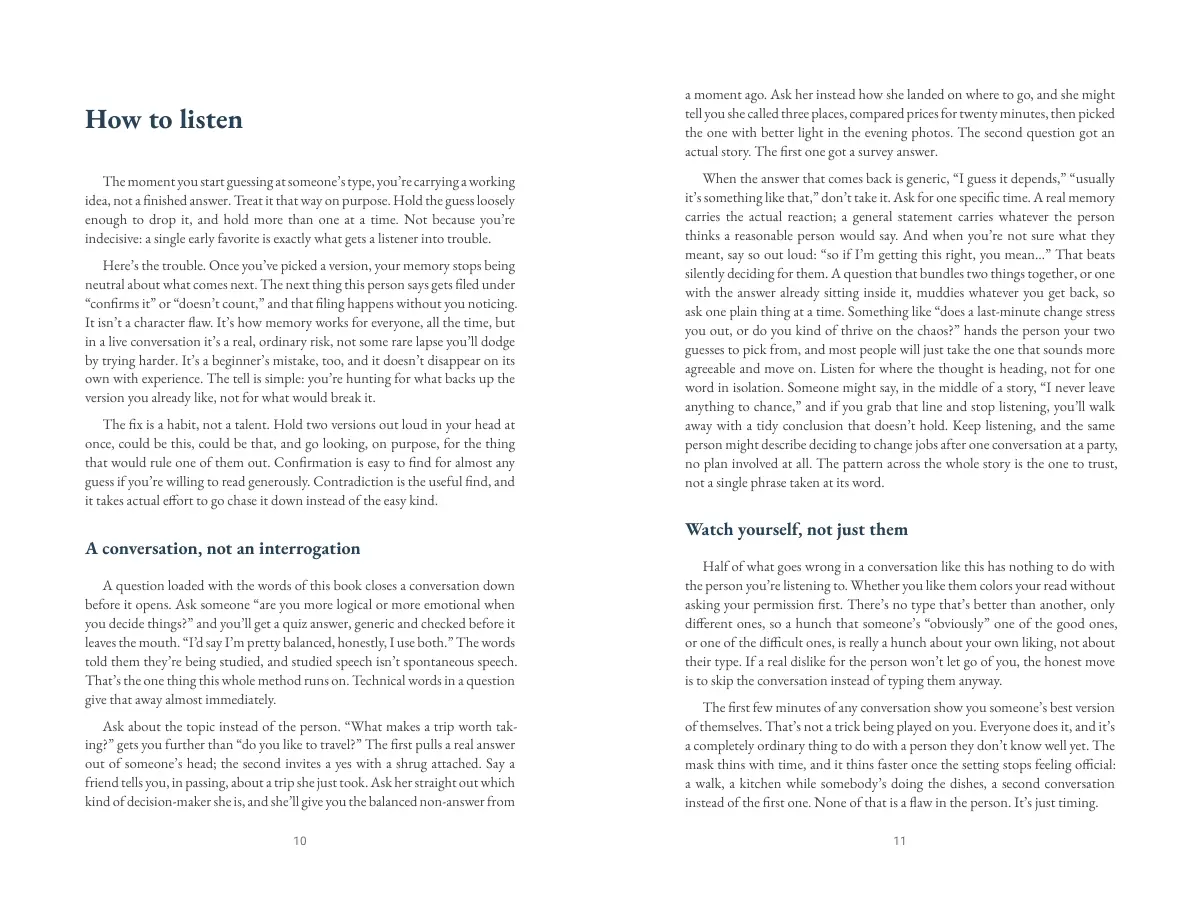
- 104 pages, 6 parts
- A page for each type
- PDF by email, usually within minutes
- In English
What you'll start to hear
- Four differences heard right awayThe world or the self, reasons or people, thing or image, plan or impulsePart II, pp. 15–35 “The Four Dichotomies”
- The two topics that do the talkingWhat a person brings up on their own and comes back to ten minutes laterPart III, pp. 36–56 “The Loud Pair”
- How the guesses narrow to one typeTwo topics cut sixteen types down to two; introversion or extraversion picks onePart IV, pp. 57–62 “From Guesses to Type”
The book's six parts
How to listen, then what to listen for, then where you'll be wrong
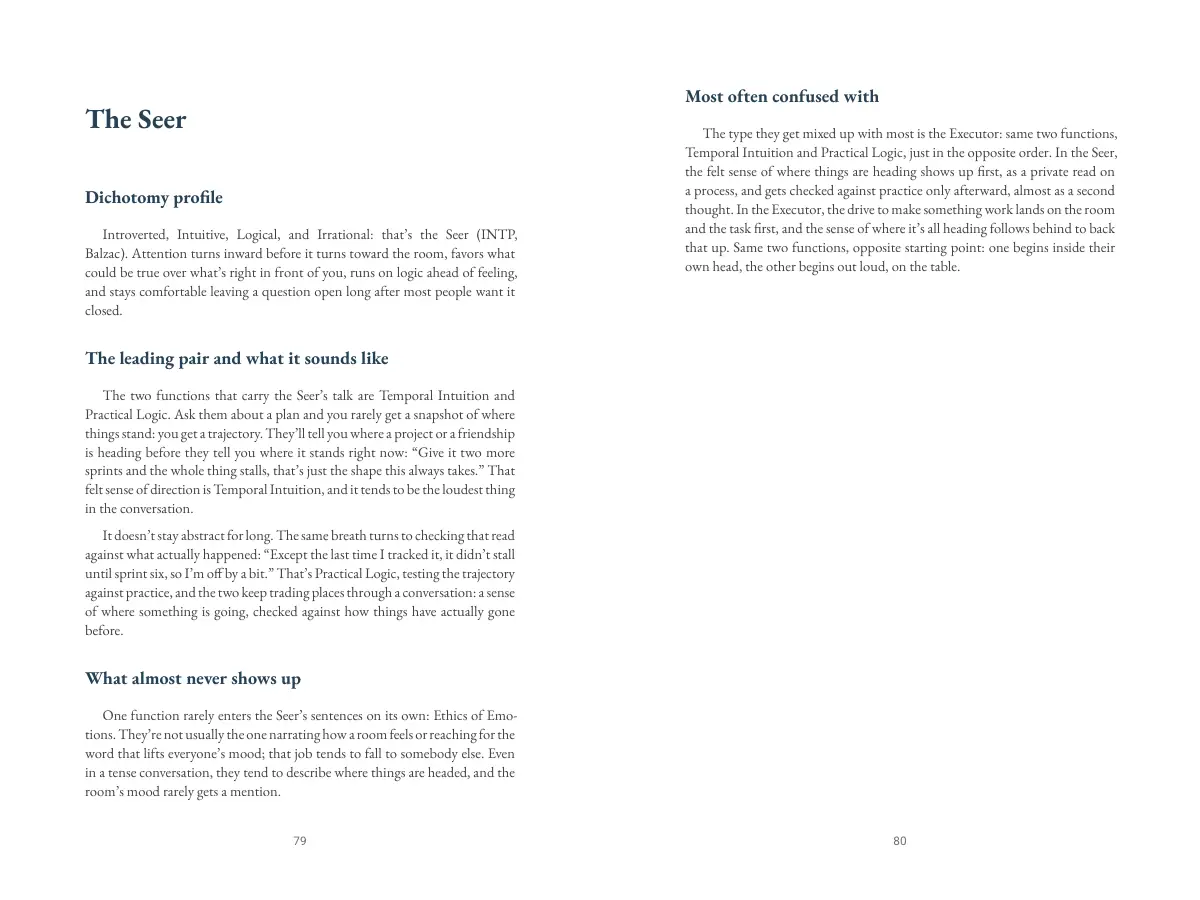
- The MethodPart I, pp. 6–14
- The Four DichotomiesPart II, pp. 15–35
- The Loud PairPart III, pp. 36–56
- From Guesses to TypePart IV, pp. 57–62
- The Sixteen CardsPart V, pp. 63–95
- Practice and LimitsPart VI, pp. 96–104
 View larger
Contents6 parts, 34 chapters
- Part I — The Method
- Why speech gives you away6
- How to listen10
- Part II — The Four Dichotomies
- Introversion and Extraversion15
- Logical and Ethical20
- Sensing and Intuition25
- Rational and Irrational30
- Part III — The Loud Pair
- The two functions that do the talking36
- Ethics of Emotions40
- Relational Ethics42
- Structural Logic44
- Practical Logic46
- Experiential Sensing48
- Volitional Sensing50
- Intuition of Possibilities52
- Temporal Intuition54
- Part IV — From Guesses to Type
- From four guesses to one type57
- Part V — The Sixteen Cards
- The Grandmaster63
- The Beacon65
- The Catalyst67
- The Harmonist69
- The Flamekeeper71
- The Warlord73
- The Herald75
- The Sentinel77
- The Seer79
- The Duke81
- The Executor83
- The Custodian85
- The Sage87
- The Overseer89
- The Harbinger91
- The Craftsman93
- Part VI — Practice and Limits
- A conversation, start to finish96
- Why you'll sometimes be wrong101
A Field Guide to the 16 Types — Why speech gives you away
104 pages, 6 parts. A page for each type. PDF by email, usually within minutes
PDF by email: usually a few minutes, up to tenFull refund within 30 days, no questions asked
You'll hear other types. Yours, only from outside
Exact type assessment from speech semantics (opens in a new window)Before you buy
You'll start to hear where someone's attention goes and what they bring up unprompted. Naming a type after one conversation is another matter; the book doesn't promise it. It's the first step, and practice comes next.
Only as a draft. Your own type can't be heard from inside: the same head would have to judge and be judged, as the book says plainly. An outside ear can confirm the version: “Exact type assessment from speech semantics”.
You don't need to know anything going in. The book introduces its terms one at a time and shows each in sample conversations: a trip, a fight, a work meeting. All it asks is that you can listen.
Because it teaches you to hear rather than describing anyone. The ear is the same whoever you're listening to. Your type is in there too: its page in Part V, with how it sounds and which type it's often confused with.