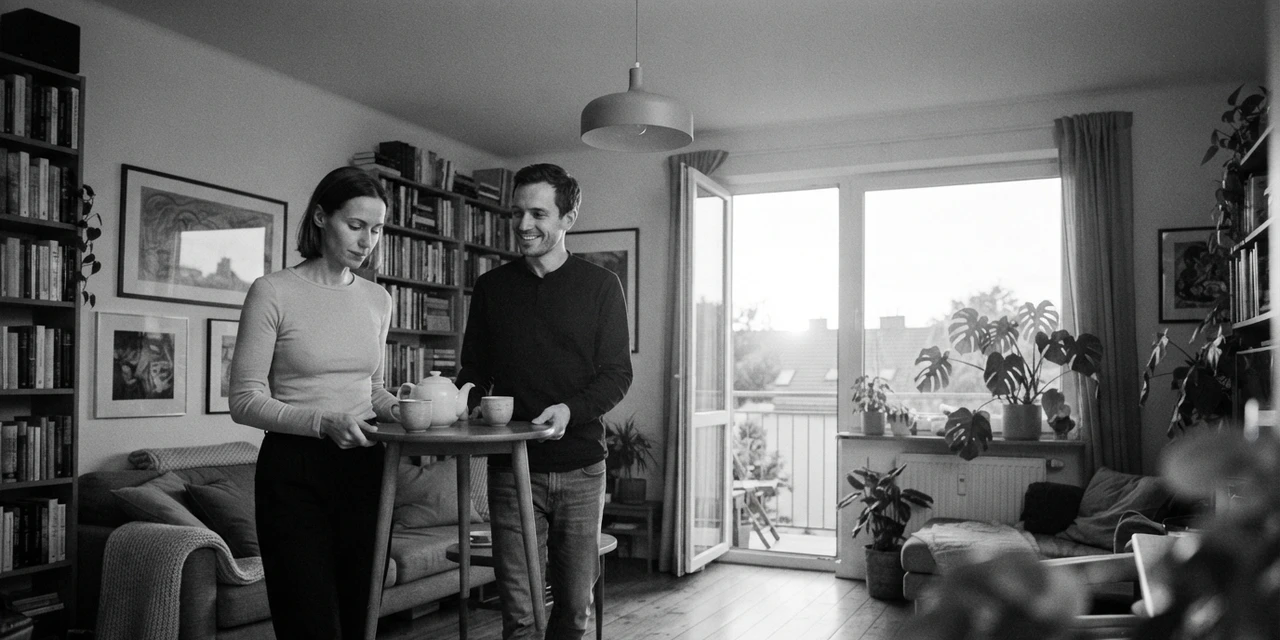
Custodian (ISFJ, known in socionics as Dreiser) and Flamekeeper (INFP, known in socionics as Yesenin) form Request relations: the Custodian is the Benefactor, the Flamekeeper is the Beneficiary, and norms, praise and priorities travel from the first to the second. ISFJ and INFP are compatible in a warm, lopsided way: the start is quick and affectionate, the middle gets expensive for the Custodian, and the pair holds once the two agree on a clear frame out loud. The Custodian brings warm praise, a steady hand and a warm home; the Flamekeeper brings a feel for the right moment and a gift for mood, and hopes for a firmer hand than it gets, since the Custodian’s firmness stops where principle stops.
Ask a Custodian and a Flamekeeper about the same 7:10 train and you’ll hear two evenings: one starts at 6:15 with paper tickets by the door, the other at the mirror, choosing a scarf. Everything below rests on two types, yours and your partner’s. If you only know yours roughly, the free CoreTypes test gives you a working version in about ten minutes: it looks at how you phrase things, not what you believe about yourself.
ISFJ and INFP at a Glance
| Type | Custodian | Flamekeeper |
|---|---|---|
| Type page | Custodian (ISFJ, Dreiser) | Flamekeeper (INFP, Yesenin) |
| Leading function | Relational Ethics | Temporal Intuition |
| Creative function | Volitional Sensing | Ethics of Emotions |
The relation between them is Request relations, with the Custodian as Benefactor and the Flamekeeper as Beneficiary. By sphere:
- Couple: a fast, tender start, then a household that tilts toward the Custodian.
- Friendship: comfortable, with low stakes.
- Work: good when the Flamekeeper owns people and the Custodian owns numbers.
ISFJ vs INFP: How Different Are These Two?
The two letters they share, I and F, show up as manners: both are quiet, soft-spoken and tactful, both put ethics first, and both like evening walks, quiet music and light rooms. The split is in talk and time. The Custodian speaks in short, concrete points, keeps a promise and its date in mind, and meets a broken one with a single sentence after a long silence. The Flamekeeper speaks in images and detours, leaves hints, says “sometime” and “there’s time,” and answers a quarrel with a loud burst that ends in a joke. At home that becomes order and deadlines on one side, possibilities and improvisation on the other, which is S versus N and J versus P at home.
How Request Relations Work Between ISFJ and INFP
In Request relations the traffic runs one way: the Custodian, as Benefactor, passes norms, assessments and priorities to the Flamekeeper, the Beneficiary, and no matching flow comes back.
The Custodian’s Creative function, Volitional Sensing, lands on the Flamekeeper’s Suggestive function, also Volitional Sensing, and that’s exactly where the Flamekeeper looks for firmness: a boundary, a decided matter, a plain “no,” and it calms down next to that firmness. The Custodian’s firmness works for ethics: it pushes back against untruth, protects close people and holds to principles. Commanding or punishing for order’s sake does not come naturally to it, and choosing for someone else makes it uncomfortable.
Marta is a Custodian and Leo is a Flamekeeper, and Leo has two job offers. “Just say yes or no,” he says. Marta asks about hours and commute. He paces that evening and takes the second offer a day later. Two weeks on: “You could have stopped me.” “I don’t give orders,” says Marta.
So the Flamekeeper asks for firmness and gets a soft, principled version, and the fewer the boundaries, the higher its tension. Where truth or order is at stake the picture changes: the Custodian turns composed and firm, and the Flamekeeper falls quiet. When Leo keeps putting off an unpleasant call to an acquaintance, Marta says evenly, “You call before ten; I’ll be next to you,” and the call gets made.
The Flamekeeper’s Leading function, Temporal Intuition, sets the household’s pace and lands on the Custodian’s Mobilizing function, also Temporal Intuition. The Flamekeeper says “hold on” and keeps a loose schedule, yet senses the moment, sees a turning point coming and, at the critical minute, hurries the others along. The Custodian switches on at clear deadlines and important matters, has no tempo of its own to hold, and either picks up the slow rhythm or fusses. At first that rhythm soothes; later it costs deadlines. The Flamekeeper is the stronger side, and its timing sometimes pays off: a “now or we lose it” about an exhibition registration closing at noon got Marta and Leo the last places.
A presentation is due Friday at 5 p.m. “One more call, I have a better idea,” says Leo. Marta fills the kettle and hunts for the flash drive. “Six in the evening,” she says. “Almost there.” The file leaves at 6:20, and on Monday Marta’s manager has a remark for her.
The ISFJ Is the Benefactor Here: What That Means
The Custodian’s Leading function, Relational Ethics, holds its sense of what’s kind and which word was a debt. The same aspect sits on the Flamekeeper’s Demonstrative function: weak but visible, so the Flamekeeper asks for assessments and catches and retells the words it hears. Early on the Custodian’s grade runs a little above the work, and the Flamekeeper takes it like wings: follows along, turns obliging, feels a duty. Later the grades drop and the tone tightens, with the reproach aimed at the very subject the Flamekeeper asked to be graded on. The Custodian is the stronger side, the positions are mentor and pupil, and the dependence on the grade runs one way.
Leo bakes his first pie. “Is this right?” “Nearly,” says Marta. After three broken promises: “How was it?” “So-so.” “You treat me like a pupil.” “You asked for the grade.” For three days questions get the answer “later.”
Comfort flows the same way. The Custodian’s Demonstrative function, Experiential Sensing, builds the household’s ease: order, meals without fuss, soft light, and gentle nudges to eat, dress warmly and rest. It lands on the Flamekeeper’s Role function, also Experiential Sensing, so the Flamekeeper accepts it gratefully, recognizes the nudging without pain, and returns care as a part it plays, visible at the start and rarer later, while the Custodian tires in silence.
In the first months Leo brings tea to Marta’s desk and straightens her lamp. By the third month the tea has stopped, and Marta sets out two cups herself. “You used to bring it,” she says. “You didn’t ask,” says Leo.
The Flamekeeper keeps some of the Custodian’s norms for a time, and what stays is what it judged useful itself. Its own priorities of time, mood and chance can’t be pressed on the Custodian.
How the Custodian Sees the Flamekeeper
The Custodian sees warmth and admiration at the start, then the gap between a promise and a deed, mood swings, and its own growing tiredness. It explains this through conscience (“they said they would, so they owe it”) alternating with compassion for someone tangled in circumstances.
The Flamekeeper’s Creative function, Ethics of Emotions, fills a room with dreaminess, festivity, hurt and swings, and waits for an echo. The Custodian’s Ignoring function is the same aspect: it reads the mood, but flattery and swings don’t buy it. The answer is a disapproving look, silence, housework. The Flamekeeper finds the echo too small, so the swings grow and the Flamekeeper feels unrecognized; the Custodian stays hard to move.
At dinner Leo says, “You’re the kindest person I know.” “Pass the salt?” says Marta. Late that night she says, “It was nice to hear. I don’t know how to answer.” “I was hoping for a smile,” he says.
The Custodian’s Vulnerable function, Intuition of Possibilities, is the Flamekeeper’s Ignoring function too, and the Flamekeeper reads it sharply: it watches chances and people, who has potential, which window is open. The Custodian doesn’t see its own chances, doesn’t ask for itself and names its achievements modestly, waiting to be noticed. The Flamekeeper spots the gap, concludes that this support doesn’t lead upward, and trusts the Custodian’s advice less; the Custodian feels a sting and a fear of seeming pushy.
Before a book event Leo rehearses at home: “Go up to him, say you’re writing about the same thing.” At the event Marta stays by the wall while the line to the author moves. They walk back in silence, and at the door Leo says, “You could have.”
ISFJ and INFP Day to Day: Seven Telltale Signs
- For a 7:10 train the Custodian waits at the door at 6:15 with paper tickets while the Flamekeeper picks between two scarves: “There’s time.” They board two minutes before departure.
- After a week of silence over a promised Saturday call, the Custodian says one sentence with a date in it, “You said you’d call on Saturday,” and the Flamekeeper wonders why it wasn’t said sooner.
- At dinner the Custodian serves fish with the bones out and a napkin on the side; the Flamekeeper picks the music and turns the lamp down.
- Forty minutes before guests arrive the Flamekeeper asks, “This shirt or that one?”; the Custodian leaves the kitchen to choose, and dinner reaches the table at 10:15 p.m.
- Whoever cooks doesn’t wash up, says the house rule; the Flamekeeper finds a loophole for days without guests, and the Custodian goes red when reminded of the earlier answer.
- Over the garden fence the Flamekeeper tells a neighbor, “Do you know how much work went into this?”, and the Custodian frowns at the praise.
- The Flamekeeper describes a house by the water for forty minutes; the Custodian asks, “When, and how much?”, and the sheet they end up with just says summer, with no date.
Daniel is a Custodian and Nina is a Flamekeeper, and a chart goes up on their fridge: who does what, which day, with boxes to tick. Nina draws a sun in the corner and signs her name on Tuesday. By Thursday Daniel has six ticks and Nina has one. He takes the chart down and folds it in half, and two days later Nina notices the empty spot on the fridge door.
ISFJ and INFP Compatibility in Love and Everyday Life
The start is quick because both are quiet, shy and gentle, and neither presses. At a party Nina finds an easy way in, a neutral question about an old record player, and nods as Daniel answers: “You put that so precisely, I’d thought the same.” “Really?” says Daniel, who talks for more than five minutes for the first time in a month. The Custodian’s attraction grows from compassion into tenderness; the Flamekeeper’s, from attention and a mood offered as a gift, and both hesitate over the first step.
The first practical request comes soon. The Custodian’s Suggestive function is Practical Logic: it asks what to do and how to finish. The Flamekeeper’s Vulnerable function is the same aspect, its weakest spot, so the “yes” comes out warm while the work stands still. Daniel needs help with a form by Thursday. Nina says “Of course!” three times, and on Wednesday the paper is blank. “You promised,” says Daniel. “Let’s do it tomorrow, I’m almost there,” says Nina, who defends herself with delays, half-measures and changes of subject. That night he fills it in himself. Neither side supplies Practical Logic to the other, so the work settles on the Custodian and promises turn into items of account.
Friction arrives through tempo and mood: the Flamekeeper answers with mood and volume, the Custodian with silence and falling grades. Fairness is the next trigger. The Flamekeeper’s Mobilizing function, Structural Logic, switches on at equal shares; the Custodian’s Role function is the same aspect, so it holds a norm with effort and formulates the rule on the fly. When Daniel’s niece stays a week and spends three evenings over a notebook with him, Nina counts aloud: “She’s got three, I’ve got zero.” “She has an exam.” “By fairness…” The Flamekeeper wins these disputes.
ISFJ and INFP Friendship
Friendship removes the household pressure: no shared chores to count, and a late arrival doesn’t wreck a deadline. The Flamekeeper starts contact easily, sets the mood and praises friends in company; the Custodian brings reliability and patience, and still counts promises, though the stakes are low.
On Saturday the Flamekeeper turns up for coffee twenty-five minutes late. The Custodian has a book, a pot of tea and no deadline; the Flamekeeper arrives with a story about a neighbor, and both call it the best meeting of the week.
Weak Points and What the Custodian Can Do
The Custodian saves up irritation in silence, and its grade is its main channel, so when the grade drops, it drops sharply. Its firmness is tied to ethics, so it has little to offer as a frame where principle isn’t at stake.
The Flamekeeper meets its own friction: tempo and deadline don’t line up, a practical request lands on a sore spot, moods grow when no frame is clear, and the position of pupil weighs on it, since obligations under pressure read as a demotion.
Honest limits. When the pile of “later” doesn’t shrink and the household stays lopsided, the pair slides toward disappointment and a drawn-out stage, in which the Custodian tries a stricter order and a timetable while the Flamekeeper lingers as if waiting for a change. A Flamekeeper without a frame for long tends to reach for someone with a firm hand and a way forward; the leaving is a phase that a pair can come back from, though trust returns slowly. When the Custodian is at its limit, distance is a sensible move: a pause in the daily routine, separate schedules.
Nina says, “I need to live apart for a while. It’s calm there, and they tell me: decide by Friday.” Daniel doesn’t argue and helps carry the boxes. Two years later he walks past her in a café without slowing, and Nina raises a hand and lowers it. A week later he writes three lines: “Saw you. Was busy. How are you?”
What helps. Agree out loud, in points: what, by when, who. Give the Flamekeeper a frame without punishment, such as a fixed hour for decisions. Split the grade into what came out and what to fix, and make a complaint the same day, in one point.
Marta and Leo try a Sunday decision hour at eleven in the kitchen, with a sheet and a pen. “Wednesday stays as planned,” says Marta. “Saturday evening is mine,” says Leo. It holds for three Sundays out of four.
Say this instead. Four pairs of the Custodian’s own lines, the first landing badly and the second working. Against the Flamekeeper’s Demonstrative function, Relational Ethics: “You promised, and it’s the same story again” becomes “This part came out well; this item we redo today.” Against the Flamekeeper’s Suggestive function, Volitional Sensing: “Decide for yourself, I won’t decide for you” becomes “This week works like this: Thursday before six you call, Friday we check in.” Against its Vulnerable function, Practical Logic: “You offered to help, so where’s the result?” becomes “Take page one, I’ll take page two, we compare tonight.” Against its Creative function, Ethics of Emotions: “Don’t start,” followed by silence, becomes “I hear that you’re hurt; say in one sentence what you want.”
At work. On a shared project the Flamekeeper takes tone, schedule and people, and the Custodian takes documents, estimates and reconciliation, with a written checkpoint on Thursday and Practical Logic left to the Custodian or a third person.
The Myth: A Flamekeeper Only Takes
The Flamekeeper takes everything the Custodian has to give, and when nothing is left to take, it goes. The Flamekeeper reaches for the Custodian’s attention because it’s looking for a firm hand, which the Custodian’s Creative function, Volitional Sensing, delivers only in a principled form. It brings its own as well: the sense of the right moment from Temporal Intuition, mood from Ethics of Emotions, praise for the Custodian in front of other people from its eye for chances and people, and a talent for organizing events.
For the Custodian’s parents’ anniversary, Leo builds the evening minute by minute: the light, the music, the toast at 7:40 p.m. Marta cries, and her parents ask for the same organizer next time.
Leaving is a phase and a tendency. It follows a long absence of a frame or a Custodian at its limit, and with a clear agreement built on the Flamekeeper’s strengths and a separate place for Practical Logic, the pair tends to stay together.
What fits into a handful of scenes here gets a much fuller treatment in the book on your type’s relationships — this pair in depth, plus all the others: how your type gets on with each of the sixteen, its own included. It covers not just how each of these pairs works, but what to do about it.
Frequently Asked Questions About ISFJ and INFP
Are ISFJ and INFP compatible?
Yes, with a built-in asymmetry: the start is easy and warm, friction arrives through tempo and practical matters, and the pair holds with a clear frame and drifts toward the later stages without one. Marta and Leo’s Sunday decision hour is the working version.
What does it mean to be the Benefactor in Request relations here?
The Custodian gives norms, warm assessments, comfort and principled protection, and gets admiration, a sense of the right moment, an eye for chances, and the Flamekeeper’s mood and contacts. It pays in time, deadlines, practical work left on itself and arguments about fair shares. Marta got the exhibition places because Leo felt the noon deadline, and took the Monday remark because the file left at 6:20.
Can ISFJ and INFP be friends without the one-sided dynamic?
They can, and with lower stakes: Temporal Intuition and Practical Logic cause less damage when no shared deadline or chore is waiting. Once a month two friends walk the embankment at dusk, the Flamekeeper telling stories off the shop signs and the Custodian pouring from a thermos.
What are ISFJ and INFP like in a romantic relationship?
The Custodian leads with Relational Ethics, adds protection through Volitional Sensing and builds a home through its Demonstrative function, Experiential Sensing. The Flamekeeper leads with Temporal Intuition, adds mood through Ethics of Emotions and small comforts through its Role function, Experiential Sensing. On a quiet evening: a plaid, a kettle, the light off, the Flamekeeper’s head on a shoulder and a half-asleep “sometime,” and the Custodian’s hand on that shoulder.
ISFJ woman and INFP man: does gender change the dynamic?
The functions decide who carries what, and they sit in the same slots whether the Custodian is a woman or a man. Ines is a Custodian and Tomas is a Flamekeeper. “By six, please,” says Ines. “I’ll be there by twenty to six,” says Tomas, and arrives at 6:35. Ines has set the table without reproach and says one thing: “Next time tell me beforehand if you can’t make it.” Her Leading function, Relational Ethics, sets the norm for the evening; his, Temporal Intuition, sets the clock.
Getting the Types Right
One thing left: making sure the type you have is the right one. That’s what professional typing is for: a specialist reads your type from your actual speech, in a recording you make at your own pace or in a live conversation, whichever you prefer. Choose whichever format feels right; either one gets you to the same place: a type you no longer have to doubt.