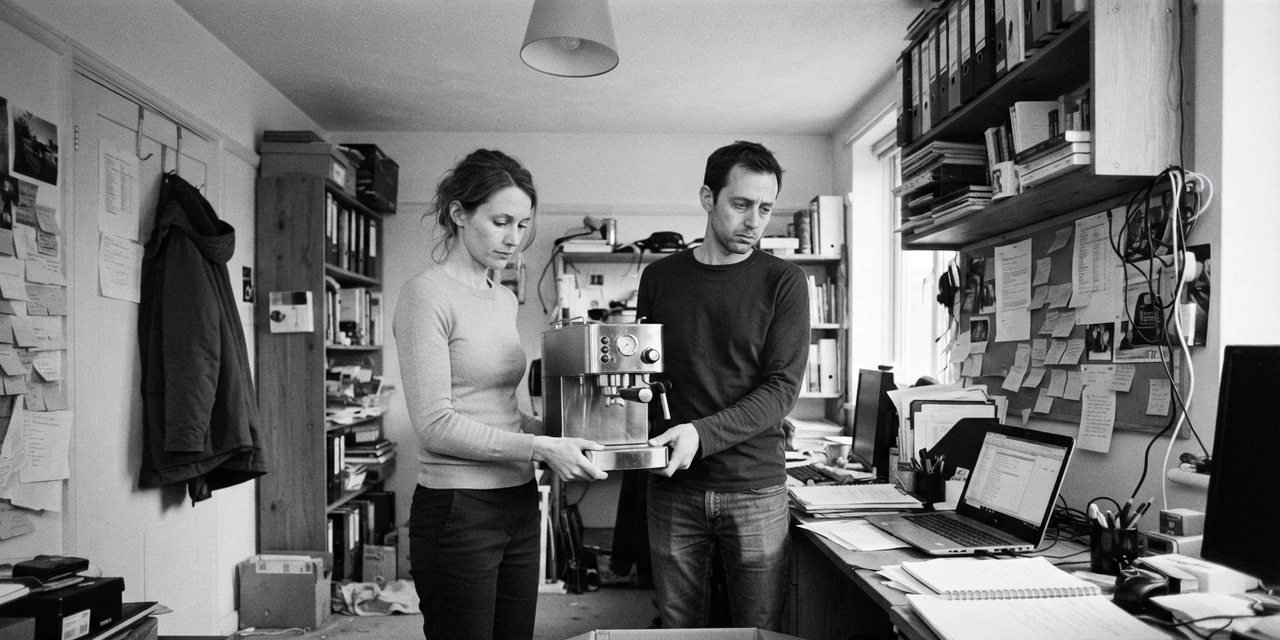
Craftsman (ISTP, known in socionics as Gabin) and Executor (ENTJ, known in socionics as Jack London) form Revision relations, a one-directional tie in which the Craftsman is the Supervisor and the Executor is the Supervisee. The two are compatible on one condition: the pressure runs from the Craftsman to the Executor, and it travels through food, rest and comfort. What wears them down is a plain remark about a skipped lunch, which lands on a bruise the Executor can’t protect, while the Craftsman usually doesn’t notice that it landed. The cost runs both ways: the Executor pays in time and rhythm, and the Craftsman pays when the Executor treats the Craftsman’s time as its own and jokes about the Craftsman’s level face.
A Craftsman who turns up on Tuesday and skips Saturday leaves an Executor writing just Tuesday in the calendar. Everything below rests on two types, yours and your partner’s. If you only know yours roughly, the free CoreTypes test gives you a working version in about ten minutes: it looks at how you phrase things, not what you believe about yourself.
ISTP and ENTJ at a Glance
| Type | Craftsman | Executor |
|---|---|---|
| Type page | Craftsman (ISTP, Gabin) | Executor (ENTJ, Jack London) |
| Leading function | Experiential Sensing | Practical Logic |
| Creative function | Practical Logic | Temporal Intuition |
ISTP and ENTJ form Revision relations: the Craftsman is the Supervisor, and the Craftsman’s leading function lands on the Executor’s most exposed one, with no hit of the same kind coming back. By sphere:
- Couple: workable when the Executor names its frames and the Craftsman keeps remarks about food and rest short.
- Friendship: lighter, built on shared projects and meetings at intervals.
- Work: strong when the Executor sets the date and the outcome and the Craftsman owns the method.
ISTP vs ENTJ: How Far Apart These Two Really Are
An Executor talks in plans, dates and outcomes: when, how much, who answers for it. A Craftsman talks in objects and sensations: comfortable, solid, noisy, scratchy. The Executor makes contact fast and takes the lead unasked; the Craftsman keeps an unhurried distance and gets to know someone through a deed, by fixing a hinge or putting a meal on the table. The Executor looks ahead to payoff and prospects, the Craftsman at what’s here now, how a thing sits in the hand or a person in a chair. What the two share is logic as a footing and respect for anyone who can do a job well.
How Revision Relations Work Between ISTP and ENTJ
In Revision relations the pressure has a direction. The Craftsman’s leading Experiential Sensing deals in comfort: the body, food, sleep, light. It lands on the Executor’s vulnerable Experiential Sensing, the same area with no defense on it. The Executor takes food and sleep as refueling, sees doctors last and hears a plea to rest as a restriction. To the Craftsman a remark about cold hands is plain good sense; to the Executor it presses on a bruise, and the answer tends to be more work.
The two also share Practical Logic, the Executor’s leading function and the Craftsman’s creative one: both think in terms of how a job gets done, which attracts them and opens a second line of friction, whose way is better.
Marta, a Craftsman, walks in on Dan, an Executor, who is assembling a shelf from his own diagram and has left out two screws that looked spare. She kneels at the corner and points to one joint.
“This one will drift.”
“I need it for two years, that’s all,” Dan says without looking up.
He redoes the corner anyway, loses an hour, and the shelf comes out dead level. “Fine. It won’t drift.” The next time, he asks Marta to wait by the window.
The Craftsman puts the way ahead of speed: small steps, fitted details, a stop at each joint to show what turned up. The Executor wants the shortest path, stages tied to dates and a verdict on the result, and loses tempo as soon as someone watches. The Craftsman’s creative Practical Logic aims straight at the Executor’s leading one, and the Executor answers with directness: why take a detour when there’s a short way?
The ISTP Is the Supervisor Here: What That Means
The Supervisor is the one whose leading function lands. A Craftsman notices other people’s discomfort first, and staying silent is hard, so the Craftsman speaks, moves the chair, puts the kettle on, and takes this for ordinary decency.
At eleven at night Nadia, an Executor, is bent over her laptop. Tomas, a Craftsman, sets a plate beside her and notices her fingers shake.
“You haven’t eaten since morning, your hands are shaking.”
“No time to feel it,” she says.
She eats half and falls asleep on the keyboard at two; in the morning there’s a blanket over her shoulders and a note, “Gone to the workshop.”
The Craftsman can’t see its own pressure. Volitional Sensing sits in the Craftsman’s ignoring slot, so a sour face or a sigh feels like a mood from the inside. The Executor, whose mobilizing function is Volitional Sensing, takes it as an order and gives way fast.
Dan has cancelled an evening with friends for a work meeting, and Marta spends two hours chopping herbs at the counter with her face turned away.
“You’ve been like this for two hours,” Dan says.
“I didn’t ask for anything,” Marta says, and she means it.
Within the hour Dan moves the meeting and rebuilds his day around the evening. Marta doesn’t see what she did.
The reverse works differently. When the Executor pushes straight (“We decide tonight, June or not”), the Craftsman rarely answers with a quarrel: Tomas takes his jacket, walks for two hours and comes back with a loaf of bread. “June.” The Craftsman learns about its own pressure late, from the Executor’s rebuilt day or growing distance.
How the Craftsman Sees the Executor
The Craftsman sees the Executor’s body first: the skipped lunch, the tight shoulders, the red eyes, the coffee standing in for a meal. Out of view stay three things: comfort is the Executor’s weak spot, the Executor fears dropping out of the work because of health, and a sour look works as a command. When the Executor dives into work, the Craftsman concludes that the Executor doesn’t look after itself, and misses that the work is an answer.
One more line connects them. The Executor’s demonstrative Intuition of Possibilities hands out prospects freely, in a showcase style that doesn’t dig deep. It sits on the Craftsman’s suggestive Intuition of Possibilities: the Craftsman forecasts poorly, waits for someone to suggest a move and notice the talent, asks for something new and finds each answer too small. Beside the Executor’s scope the Craftsman’s own mastery can look small, and the dry reaction comes from there. The Craftsman pays for the pull with a hunger for ideas that receive a showcase and with reproaches about time.
When Dan walks in with the news that his contract is signed and the project is his, Marta listens, nods and washes her hands.
“When do you sleep on a schedule like that?”
“I’m talking about the contract.”
Dan goes quiet, and his next piece of news goes to a friend, by phone, from the car. A month later Marta asks why he didn’t tell her. “You asked about sleep.”
ISTP and ENTJ Day to Day: Seven Telltale Signs
- The Craftsman sets a cup of tea by the Executor’s keyboard unasked, and the Executor finds it cold at midnight.
- The Craftsman’s first question is when the Executor last ate, and the reply is “No time.”
- “Five minutes” runs on the Executor’s watch and on the Craftsman’s mood, and a tea break stretches to an hour.
- The fridge calendar is planned by the hour on the Executor’s side and blank on the Craftsman’s: the Executor writes Friday, six o’clock, into it, and the Craftsman says “this week.”
- The Executor eats standing up in five minutes in silence; the Craftsman sits forty minutes over the same meal and tells a story.
- The Craftsman’s tool bag stands in the hallway for a week, a job started and unfinished.
- The Craftsman moves a lamp that was shining in the Executor’s eyes without a word; the Executor notices a week later.
On his first visit Ben, a Craftsman, fixes Lena’s shelf and says the rest can wait until next time. Lena, an Executor, hears “Saturday” and waits until seven with groceries bought for two. Ben turns up on Tuesday and finds a list of six shelves at the door.
“You said the rest next time,” Lena says. “Which Saturday?”
Ben reads the list and turns toward the door. “I don’t come as a work crew.” Two days later he brings handles from the market and fits two.
ISTP and ENTJ Compatibility in Love and Everyday Life
The Craftsman is drawn to the Executor’s scope and ideas, the Executor to the Craftsman’s calm hands and above all to an evening without rush.
Tomas arranges one for Nadia, with soup and soft light. She relaxes for the first time in a month and falls asleep on the sofa at nine. “Best evening in a month,” she says in the morning. “But I have a deadline today.”
The usual run, as a tendency: the Craftsman arrives with a repair or a soup, which the Executor takes as care and as a down payment. Then come adjustments to food, sleep, tempo and method, pushback with jokes and a raised voice, the Craftsman’s silence, and a request for ideas that meets dryness and stops. Time, rhythm and deadlines slip, the distance grows, and what stays is a habit of hearing “Did you eat?” Some pairs don’t get that far.
On the ethics line the two want different things. The Craftsman’s mobilizing Relational Ethics shows warmth through deeds and avoids frames and a direct “let’s get clear on us”; under pressure the Craftsman goes quiet and returns on its own schedule. The Executor’s suggestive Relational Ethics asks for certainty, loyalty and clear guarantees, and counts a favor as an application.
Three months in, Karl, an Executor, asks Ines, a Craftsman, for certainty, “so I can plan.”
“We have dinner together,” Ines says.
“That doesn’t answer it.”
“What do you want to hear?”
Karl sets a rule: Tuesday and Saturday. Ines takes Tuesday and skips Saturday, blaming the road, and in his calendar Karl writes just Tuesday. At her mother’s birthday he stays ten minutes, hands over the gift and leaves for work, the Executor’s formality about family rituals at full strength.
Time is where the Executor hits back. The Executor’s creative Temporal Intuition runs a dense schedule and spends other people’s time as casually as its own. The Craftsman’s role Temporal Intuition is weak but nimble in defense: it hurries slowly, lets deadlines stretch and avoids firm promises. Marta arrives at ten to eight for a dinner set at seven. “Your time is rubber, and you know everything about mine,” Dan says, and Marta takes her jacket and goes. At night he writes “I went too far”; the morning answer is “You’re right about the time. Don’t say it like that.” Density energizes the Craftsman and slowness calms the Executor, but deadlines remain the pair’s main minefield.
The Craftsman’s vulnerable Ethics of Emotions takes a lighter hit in return, at a higher cost to the Executor. The Executor’s role Ethics of Emotions makes the Executor the cheerful one, with a joke where a feeling would go; the Craftsman keeps feelings behind a level face and, when patience runs out, answers with one short sharp phrase and regrets it. When Nadia jokes about Tomas’s unchanging face, he spends three hours in the workshop and says one sentence late at night: “Don’t joke about me like that.” “I’m joking.” “I know.” A week of polite silence follows, until Tomas brings her dinner at her office. The Executor adapts to the Craftsman’s mood, laughs at the jokes and checks whether offense was taken, which costs weeks of icy courtesy.
Arguments about fairness go nowhere: the Craftsman’s demonstrative Structural Logic reaches for “that’s not how it’s done” and “I read somewhere,” and the Executor’s ignoring Structural Logic hears a shaky reference at once. When Ines argues for her vacation split, “That’s unfair, I read about it,” Karl says, “Send me the link,” and the article says something else. A flat “Very convincing” about a presentation gets “Tell me what’s wrong,” and one exact remark is accepted at once.
ISTP and ENTJ Friendship
Friendship between these two lives on a shared job. The Craftsman helps with hands, the Executor brings scope and organization, and both stay loyal to their own team.
Simon, a Craftsman, and Hannah, an Executor, are building a veranda at a friend’s country house. Hannah cuts the job into stages with dates; Simon works in small handfuls, a day for the table, a day for the windows. On the fifth weekend Simon wants paint to wait until the boards are fixed, and Hannah’s schedule says paint today.
The veranda stands, the schedule is about seventy percent done, the joints are exactly right and no offense is taken. They settle it: dates are Hannah’s, joints are Simon’s.
At this range the Craftsman’s remark about food lands softer: at Simon’s monthly dinner Hannah laughs when he says, “You actually sat down tonight.” Distance suits them: a dinner a month, a trip a season.
Weak Points and What a Craftsman Can Do
The Executor has snags of its own: spending the Craftsman’s time freely, pushing hard where the Craftsman leaves, asking a partner who gives hints for definiteness, and answering care with work. The Craftsman’s own are kind remarks about food and rest, a sour face that works as an order, and vague promises.
When Distance Is the Best Solution
Sometimes distance is the best answer. What holds at a remove: meetings by arrangement, a joint project without a shared household, a weekly dinner; the blow to the Executor’s vulnerable Experiential Sensing is weaker, and the Craftsman’s rhythm of coming and going is natural. What breaks at close range is a shared home: daily food and sleep, repairs with deadlines, family rituals, quiet pressure in one room. The signs: the Executor misses deadlines, stops sharing successes, eats and sleeps apart, the jokes turn into icy politeness, and the Craftsman says “You’ve become a stranger” without understanding why.
Two years in, Nadia rents a room “for a week, for a project.” The week turns into a month, and Tomas visits on Thursdays.
“It’s easier for me to work like this,” she says.
“For me too,” he says.
Six months later both say it’s better this way, and they keep two homes, Thursday dinners and summer trips. That’s a tendency, and some pairs hold like that for years. If the conflict comes with threats, violence or public humiliation from either side, it has left the ground of type dynamics and calls for distance and support from outside.
Say This Instead
Four of the Craftsman’s own lines tend to hit, and each has a better version. “Lie down and sleep, it’ll pass” hits the vulnerable Experiential Sensing, and an Executor with a fever answered, “Don’t say that to me.” The line that works is “Finish up; I’ll bring tea at eleven and you decide then.” “That’s the wrong way, the seam will go in a year” hits the leading Practical Logic, and the better line is “I’ll show you one joint, the rest is your way.” “We have dinner together, what more do you need?” hits the suggestive Relational Ethics; better is “I come on Tuesdays, and I can’t promise Saturday.” “It’ll be ready this week” hits the creative Temporal Intuition; better is “Rough draft by Friday, clean version Wednesday.”
At Work
At work both are strong in Practical Logic: the Executor organizes and sets the deadline, the Craftsman handles the technical side. Lena runs a site and Ben does the finishing; she names the date and the conditions (“By Friday the passage is clear and the floor is level”) and leaves the method to him. What breaks it is “this week” against “by Friday” and control at each step.
Myth: An Executor Loses Work, Rhythm and Strength Next to a Craftsman
Next to a Craftsman, an Executor inevitably loses its work, its rhythm and its strength. That falls apart on the mechanism: the blow travels through one slot, comfort and rest, and the Executor’s leading Practical Logic stays untouched as long as the Executor names its frames.
One evening Karl says to Ines: “I work until nine, then dinner.” Ines sets the table for nine, brings no tea and makes no remarks. “Understood,” she says. The work doesn’t suffer, the dinner isn’t skipped, and in the second week the frame still holds.
The way out is a phase and a tendency: many pairs never reach it, and others settle at a distance that costs them little.
What fits into a handful of scenes here gets a much fuller treatment in the book on your type’s relationships — this pair in depth, plus all the others: how your type gets on with each of the sixteen, its own included. It covers not just how each of these pairs works, but what to do about it.
Frequently Asked Questions About ISTP and ENTJ
Are ISTP and ENTJ compatible?
Yes, with one caveat built into the relation: the pressure runs one way, from the Craftsman to the Executor. The pair gets a shared language of work and the Executor’s scope, and pays in comfort and time. A frame helps: Karl’s “I work until nine, then dinner” holds because Ines sets the table for nine.
What draws a Craftsman to an Executor, and the reverse?
The Craftsman is drawn by drive, ideas and pace, since the Executor’s demonstrative Intuition of Possibilities meets the Craftsman’s suggestive one. The Executor is drawn by calm hands and an unhurried evening. The pull cools when the Craftsman gives hints where the Executor needs certainty, and when the Executor loses time and stops bringing news: Dan stopped telling Marta about contracts after she asked about his sleep.
What is it like to be the Supervisor?
From the inside it feels like good sense: Marta kept chopping herbs with her face turned away and honestly believed she hadn’t asked Dan for anything, while he moved a meeting. The Craftsman learns of its own pressure through the Executor’s distance and pays with a hunger for ideas that receive a showcase and with the reproach about time, as in Dan’s line about Marta’s rubber hours.
What are ISTP and ENTJ like in a romantic relationship?
The Craftsman’s leading Experiential Sensing brings touch, warmth and food, while the Executor’s vulnerable Experiential Sensing relaxes slowly: Nadia fell asleep on the sofa at nine. In Relational Ethics the Craftsman shows warmth through deeds and the Executor’s suggestive function asks for definiteness, so the Craftsman’s hint meets the Executor’s request for a plan.
ISTP woman and ENTJ man: does gender change the dynamic?
The functions stay the same, and so does the tendency: the Craftsman’s leading function meets the Executor’s vulnerable one. Ruth, a Craftsman, sees that Felix, an Executor, is on his second day of coffee and sandwiches, and sets soup beside his laptop.
“You’ve been on coffee for two days, the soup’s hot.”
“I’m finishing. After dinner.”
Dinner happens at ten, Felix eats standing, and Ruth goes to the workshop without a word.
Making Sure of Your Type
One thing left: making sure the type you have is the right one. That’s what professional typing is for: a specialist reads your type from your actual speech, in a recording you make at your own pace or in a live conversation, whichever you prefer. Choose whichever format feels right; either one gets you to the same place: a type you no longer have to doubt.